Kitchen Backsplash Installation Cost Per Square Foot New York
By the KitchenBath Guides Editorial Team — reviewed for accuracy. Last updated October 2026. This article is for informational purposes and reflects typical market pricing; verify current details with licensed contractors before starting any project.
The backsplash is the smallest full-trade surface in a kitchen remodel — a few square feet of tile that carries a disproportionate share of the visual identity. Its pricing per square foot is honest and predictable; its total moves with material choice more than anything else.
This guide prices kitchen backsplash installation per square foot for 2026: the labor-material split, the tile classes and their installed rates, and the edge details that quotes price separately.
Kitchen Backsplash Installation Cost Per Square Foot — At a Glance for US
Kitchen backsplash installation runs $900–$4,200 per square foot installed in 2026 — $8–$25 for ceramic and subway classes, $15–$40 for glass and premium stone, with labor at $8–$12 per foot fairly stable across materials. A typical 30 sq ft backsplash totals $900–$2,500 installed by tile class. This is a realistic planning number for the United States in 2026, not a marketing low-ball.
| Line Item | Typical Range (USD) | What Drives It |
|---|---|---|
| Ceramic/subway tile (installed) | $8–$18 | Per sq ft — the value standard |
| Glass tile (installed) | $15–$30 | Per sq ft — premium visual class |
| Premium stone/slab backsplash | $25–$60 | Per sq ft — quartzite and full-slab class |
| Labor only (per sq ft) | $8–$12 | Fairly stable across tile classes |
| Edge and trim details (per project) | $100–$400 | Bullnose, Schluter profiles, outlets |
Understanding Kitchen Backsplash Installation Cost Per Square Foot
The labor floor is the anchor: $8–$12 per square foot installs most tile honestly, and the number moves little between ceramic and glass. The material ladder drives everything above it — from $2–$5 subway ceramic to $15–$30 glass mosaics to full-slab stone at premium fabrication rates.
The details price separately: trimmed edges (metal profiles run $20–$40 per linear foot installed), outlet cutouts ($15–$35 each in stone), and switch-plate coordination. Waterproofing behind ranges and sinks adds thin layers of membrane and cost. The honest per-foot comparison includes the trim, or it is not the same project.
What Moves the Price Up or Down
Per-foot pricing moves on tile size and pattern complexity as much as material class. Mosaics and herringbone multiply the labor; large-format slab reduces it.
| Factor | Cost Impact | Detail |
|---|---|---|
| Tile class (ceramic to stone) | ±$7–$40/sqft | The material ladder — dominant driver |
| Pattern complexity | +20–40% labor | Herringbone, chevron and mosaics multiply cuts |
| Edge treatment | +$100–$400/project | Trim profiles, bullnose, outlet cutouts |
| Area size (20–40 sqft typical) | ±15–25% | Small areas carry setup costs per-foot |
Backsplash Options and Installed Pricing
Four tile classes cover the backsplash market. Each prices a different visual-material trade.
| Option | Description | Best For | Cost Level |
|---|---|---|---|
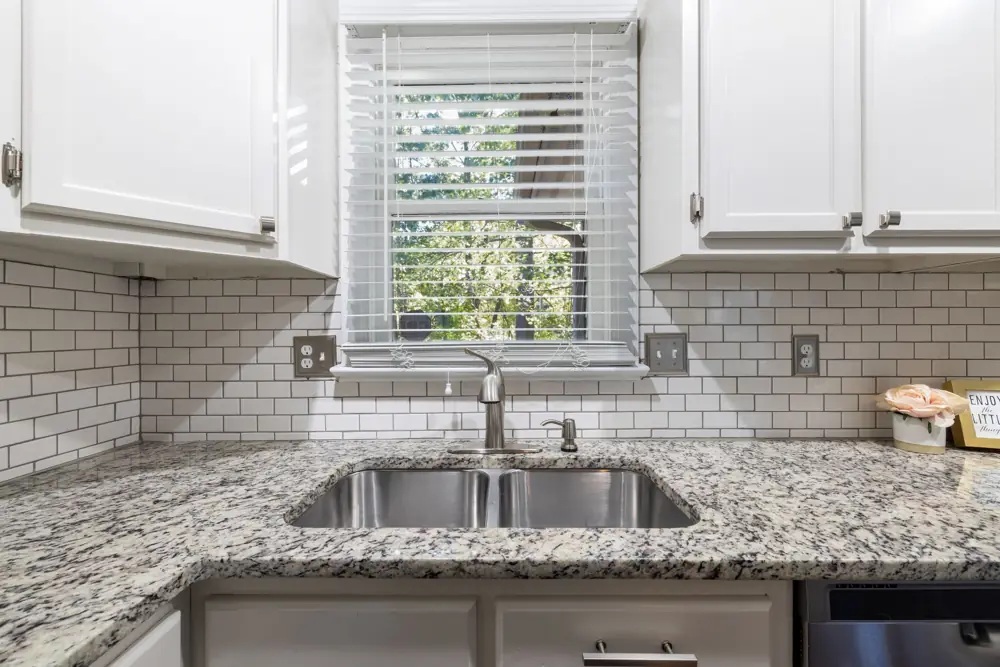
| Subway/ceramic field tile | The classic 3×6 class, running bond | Value standard, timeless looks | $8–$18/sqft installed |
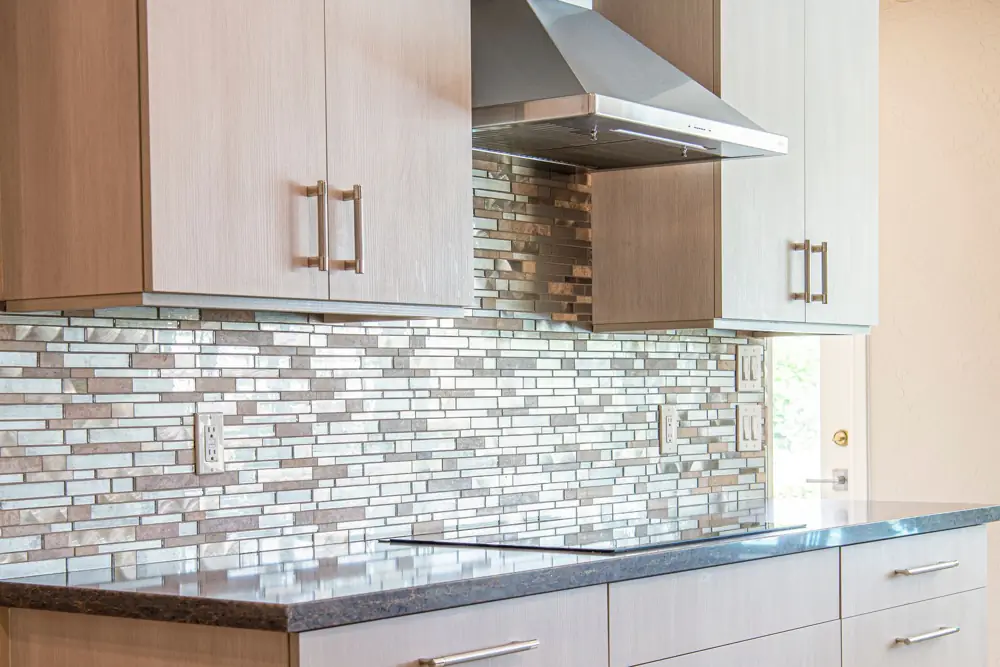
| Glass and mosaic | Sheet mosaics, glass field tile | Light and color play | $15–$30/sqft installed |
| Porcelain large-format | 12×24 and larger, minimal grout | Modern continuity, low maintenance | $14–$28/sqft installed |
| Full-slab stone | Quartz or quartzite slab matching counters | The seamless premium look | $25–$60/sqft installed |
The class decision is visual and budget together — the labor under each is more stable than the material ladder above it.
Three Realistic Project Scenarios
The subway standard — $900–$1,400
A 30 sq ft backsplash in classic white subway, running bond.
- Ceramic tile at $2–$4/sqft — $60–$120
- Labor at $8–$12/sqft — $240–$360
- Trim and grout — $120–$250
Why this matters: the subway backsplash remains the honest value standard — timeless, cheap to execute, easy to repair.
The glass-mosaic upgrade — $1,500–$2,400
The same area in glass sheet mosaics with accent banding.
- Glass tile at $10–$20/sqft — $300–$600
- Labor with mosaic complexity — $300–$450
- Trim and sealing — $150–$300
Why this matters: the glass upgrade buys light play at mosaic labor rates — the pattern complexity prices the visual.
The slab-matching premium — $3,200–$4,200
A full-slab quartzite backsplash matching the counter, book-matched.
- Slab material and fabrication — $2,000–$2,800
- Installation and cutouts — $700–$1,000
- Outlet coordination — $150–$300
Why this matters: the slab backsplash is counter fabrication continued vertically — priced by the fabricator, not the tiler.
Backsplash totals cluster by class; the trim details are where quotes differ for the same tile.
Sample Budget Breakdown
The table below shows how a typical mid-range budget for kitchen backsplash installation cost per square foot distributes across materials, labor and compliance in the United States. Adjust the percentages to your own scope before using it as a savings target.
| Category | Estimated Amount | Explanation | Optimization Tip |
|---|---|---|---|
| Tile material | $120–$900 | 15–25% of standard projects | The class decision lives here |
| Installation labor | $240–$500 | 30–35% | Stable per-foot; complexity multiplies it |
| Trim, grout, sealing | $150–$400 | 10–15% | The detail line honest quotes itemize |
| Slab fabrication (premium) | $2,000–$2,800 | premium projects | Fabricator pricing continues from the counter project |
Every figure above is an indicative 2026 market range. Final quotes move with site conditions, contractor availability and the exact specification you lock in.
From Quote to Completion: the Typical Timeline
Most kitchen backsplash installation cost per square foot projects follow the same five-stage rhythm. Knowing the calendar before you sign prevents the two classic frustrations — feeling rushed into a deposit, and being surprised by a mid-project gap while materials arrive.
- Week 0: scope and three quotes — A measured scope with cabinet counts and fixture list turns phone guesses into comparable quotes; walkthroughs take an hour each.
- Week 1–4: ordering the long-lead items — Cabinets at 4–10 weeks, counters at 2–3 after template, specialty tile and fixtures as they arrive — the calendar is set the day you sign.
- Week 2: permits — Structural, electrical and plumbing permits file in a day and issue in 1–3 weeks where required; inspectors schedule their visits into the project.
- Construction: 3–8 weeks on site — Demo and rough-in week one, cabinet and counter weeks two-to-four, finishes and inspections closing out the tail.
- Final 2 weeks: punch list and close-out — Doors adjusted, caulk cured, final inspections passed, and the lien waiver packet collected before final payment.
Smart Ways to Control the Budget
Cost control on kitchen backsplash installation cost per square foot is mostly about scope discipline and timing. These are the strategies that consistently deliver the largest savings:
Remodel in the shoulder months
Contractor calendars empty between post-holiday winter and late autumn; January-to-March quotes run noticeably softer than spring.
Advantages:
- Directly reduces the controllable parts of the quote
- No impact on quality or compliance when scoped correctly
Disadvantages:
- You may be without a kitchen island through the holidays if something slips.
- Requires planning lead-time you may not have on urgent timelines
Stage the project in phases
Splitting counters-and-floors from cabinets-and-plumbing keeps a working kitchen between phases and spreads cash flow.
Advantages:
- Directly reduces the controllable parts of the quote
- No impact on quality or compliance when scoped correctly
Disadvantages:
- Two mobilizations cost more in total than one — phase carefully or the savings invert.
- Requires planning lead-time you may not have on urgent timelines
Get three itemised quotes, line by line
The same kitchen scope quotes $10,000 apart between contractors; only line-level comparison shows whether the gap is labor, materials or padding.
Advantages:
- Directly reduces the controllable parts of the quote
- No impact on quality or compliance when scoped correctly
Disadvantages:
- Takes two weeks of evenings and a spreadsheet nobody enjoys building.
- Requires planning lead-time you may not have on urgent timelines
Keep the footprint, change the finishes
Leaving plumbing, gas and walls where they are cuts 15–25% off a full remodel — moving a sink or range is where budgets quietly double.
Advantages:
- Directly reduces the controllable parts of the quote
- No impact on quality or compliance when scoped correctly
Disadvantages:
- You live with a layout the previous owner chose, which for some kitchens is exactly the problem.
- Requires planning lead-time you may not have on urgent timelines
Permits, Rules and Safety
Backsplashes carry no permit requirements anywhere covered. The electrical boxes behind them — outlet positioning and GFCI compliance — are electrician work if any box moves, and inspection territory if circuits change.
- Moving plumbing, gas lines or opening walls triggers permits in all five countries covered — unpermitted work resurfaces at resale as a disclosure problem.
- A structural engineer letter is required for wall removal before the permit issues; load-bearing determinations are never a contractor guess.
- Kitchen electrical upgrades (added circuits, panel work) need inspection — and the inspection paperwork is what insurers ask for after a claim.
Maintenance and Long-Term Ownership Costs
The project price is only the first line of the budget. These recurring items are what owners in the United States actually spend money on after the crews leave:
| Task | Frequency | Typical Cost | Why It Matters |
|---|---|---|---|
| Cabinet hinge and drawer adjustment | Yearly | DIY (free) | Soft-close hardware drifts out of alignment with use; a screwdriver tune keeps doors closing the way they did in month one. |
| Grout and caulk inspection | Yearly | DIY ($10–$40) | Cracked caulk behind sinks and backsplashes is how water reaches cabinets and subfloors. |
| Refrigerator coil cleaning | Twice yearly | DIY (free) | Dust-choked coils raise energy bills and shorten compressor life — 15 minutes with a brush. |
| Range hood filter degreasing | Quarterly | DIY (free) | Grease-loaded filters lose capture efficiency and become a stovetop fire accelerant. |
Grout is the maintenance line: sealed grout reseals every 1–2 years ($20–$40 DIY), and the stain discipline that keeps white grout white. Slab backsplashes escape grout maintenance entirely — part of what their premium buys.
Frequently Asked Questions
How much does it cost to install a kitchen backsplash per square foot?
$8–$25 per square foot installed for ceramic and standard classes, $15–$40 for glass and premium; labor alone runs $8–$12 per foot, with materials carrying the rest of the ladder.
How much backsplash tile do I need for a standard kitchen?
20–40 square feet covers most runs — a 10-foot counter run with 18-inch backsplash is 15 sq ft; full-height behind a range adds 10–12. Add 10–15% waste for cuts and pattern matching.
Is a slab backsplash worth the cost over tile?
At $25–$60 per square foot it prices as premium fabrication — worth it when matching or book-matching the counter and escaping grout lines; tile wins the value comparison everywhere else.
Can I install a backsplash myself?
Yes — the most DIY-honest tile project: flat wall, small area, forgiving patterns. Subway tile in running bond is the starter class; mosaics and stone edges are the specialist lines.
Summary
Planning kitchen backsplash installation cost per square foot in the United States starts with an honest range — $900–$4,200 for the scenarios most households actually install — then works backwards through tile-class selection and detail honesty.
The backsplash prices by class: subway at the value floor, glass for light, slab for seamlessness. Price the trim with the tile, seal the grout you choose, and let the smallest full-trade surface deliver its outsized visual share. Collect at least three itemised quotes, confirm the permit path before signing, and hold a 10–15% contingency for site surprises. Those three habits protect more budget than any product choice.
Related Guides
- Kitchen Recessed Lighting Installation Cost Melbourne
- Kitchen Sink Plumbing Relocation Rough-In Cost Illinois
- Kitchen Remodel Budget Tiers Basic Mid High End Canada
- Condo Kitchen Remodel Cost Rules and Approval Fees Florida
- Kitchen Renovation Permit Requirements Cost by State USA
- Kitchen Remodel Cost 10×10 Kitchen USA 2026 Guide