Laminate Countertops Cost Per Square Foot Installed New Zealand
By the KitchenBath Guides Editorial Team — reviewed for accuracy. Last updated October 2026. This article is for informational purposes and reflects typical market pricing; verify current details with licensed contractors before starting any project.
Laminate owns the value tier of benchtops everywhere, and New Zealand prices it with a domestic twist: locally laminated product competes with imports at installed rates that make the value case stronger than the material reputation suggests.
This guide prices laminate countertops installed in New Zealand for 2026: the per-square-metre economics, the laminate class ladder (standard to premium textures), and the edge-and-profile options that move the number.
Laminate Countertops Cost Per Square Foot Installed — At a Glance for NZ
Laminate benchtops run NZ$32–NZ$91 per square metre installed in New Zealand 2026 — NZ$160–$450 by class (roughly NZ$15–$42 per square foot), from standard postformed product to premium textured and waterfall-profiled laminates. The class ladder prices visual depth; the substrate and profile options price the fit. This is a realistic planning number for New Zealand in 2026, not a marketing low-ball.
| Line Item | Typical Range (NZD) | What Drives It |
|---|---|---|
| Standard postformed laminate (installed) | NZ$210–NZ$340 | NZ$/m² — the classic value product |
| Premium textured laminates | NZ$340–NZ$490 | NZ$/m² — matte, stone-look textures |
| Designer/waterfall profiles | NZ$490–NZ$580 | NZ$/m² — square edges, premium finishes |
| Square-edge upgrades (per metre) | NZ$32–NZ$78 | NZ$ — the profile ladder above postformed |
| Sink and hob cutouts (each) | NZ$78–NZ$200 | NZ$ — fabrication by opening |
Understanding Laminate Countertops Cost Per Square Foot Installed
The NZ laminate market carries the local advantage: domestic laminators run competitive pricing on standard product — NZ$160–$260/m² installed for the postformed classic. The class ladder climbs through the premium textures (the matte and stone-look laminates that close the visual gap to engineered product) to the designer profiles with square edges and waterfall capability at NZ$380–$450.
The value case is the honest pitch: at NZ$160–$260 installed, laminate delivers the functional benchtop at a fifth of entry-engineered pricing. The trade is the durability calendar — laminate scores, burns at hot-pan contact, and the seam-and-edge lines that the years expose. The premium textured classes carry the visual recovery (stone-looks that photograph honestly) while the substrate underneath stays laminate-honest.
What Moves the Price Up or Down
Laminate moves on class, profile and the substrate tier. The value position is constant — the ladder tunes the look.
| Factor | Cost Impact | Detail |
|---|---|---|
| Class (standard to designer) | ±NZ$100–$290/m² | The visual ladder |
| Profile (postformed vs square) | ±NZ$25–$60/m | The edge-look upgrade |
| Substrate tier (HMR moisture-resistant) | ±NZ$20–$50/m² | The wet-area upgrade worth pricing |
| Cutout count | ±NZ$60–$150 each | Sinks and hobs by opening |
Laminate Classes and What They Buy
The NZ market at honest alignment:
| Option | Description | Best For | Cost Level |
|---|---|---|---|
| Standard postformed | Classic profile, value patterns | The pure value benchtop | NZ$160–$260/m² installed |
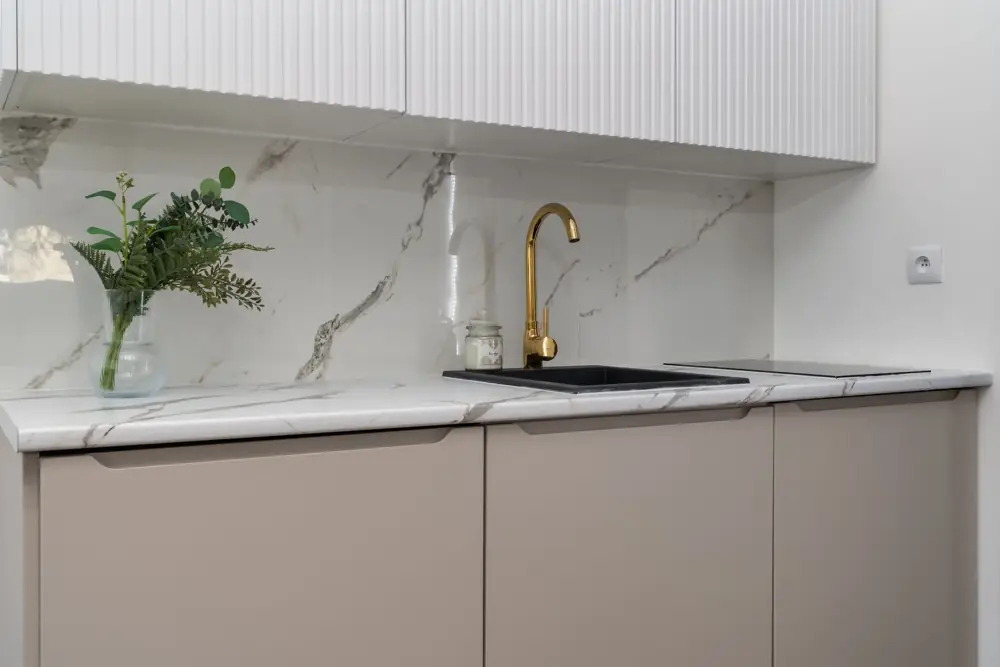
| Premium textured | Matte and stone-look surfaces | The visual-recovery tier | NZ$260–$380/m² installed |
| Designer profiles | Square edges, waterfall capability | The premium-laminate look | NZ$380–$450/m² installed |
The ladder prices the look; the value position holds across it — every class undercuts engineered entry pricing.
Three Realistic Project Scenarios
The standard-value kitchen — NZ$1,050–NZ$1,700
A 5m² benchtop in standard postformed laminate.
- Material (5m² standard) — NZ$520–NZ$840
- Fabrication and install — NZ$390–NZ$650
- Cutouts (sink) — NZ$78–NZ$200
Why this matters: the standard product delivers the working benchtop at value pricing — the honest rental-and-starter case.
The premium-texture upgrade — NZ$1,700–NZ$2,450
The same kitchen in stone-look textured laminate.
- Material (premium texture) — NZ$840–NZ$1,250
- Fabrication and install — NZ$520–NZ$780
- Cutouts — NZ$78–NZ$200
Why this matters: the textured class closes the visual gap at a third of engineered pricing — the value-visual peak of the ladder.
The designer-profile build — NZ$2,450–NZ$2,900
Square-edge designer laminate with waterfall island run.
- Material (designer class) — NZ$1,250–NZ$1,450
- Square-edge fabrication — NZ$260–NZ$520
- Install and cutouts — NZ$260–NZ$460
Why this matters: the designer class prices the premium-laminate look — square profiles and waterfall runs the postformed product cannot carry.
Laminate quotes compare cleanly by class; the value position versus engineered product is the frame around every tier.
Sample Budget Breakdown
The table below shows how a typical mid-range budget for laminate countertops cost per square foot installed distributes across materials, labor and compliance in New Zealand. Adjust the percentages to your own scope before using it as a savings target.
| Category | Estimated Amount | Explanation | Optimization Tip |
|---|---|---|---|
| Material by class | NZ$520–NZ$1,450 | 50–55% | The visual ladder |
| Fabrication and install | NZ$390–NZ$780 | 25–35% | The profile and cutout work |
| Substrate upgrades | NZ$130–NZ$320 | HMR where wet | The moisture tier worth pricing at sinks and dishwashers |
Every figure above is an indicative 2026 market range. Final quotes move with site conditions, contractor availability and the exact specification you lock in.
From Quote to Completion: the Typical Timeline
Most laminate countertops cost per square foot installed projects follow the same five-stage rhythm. Knowing the calendar before you sign prevents the two classic frustrations — feeling rushed into a deposit, and being surprised by a mid-project gap while materials arrive.
- Day 1–5: slab selection — Choose at the yard or showroom; the slab you saw is the slab you get — reserve it in writing.
- Day 5–15: template — Digital templating after cabinets are set and leveled; an hour on site, and the file goes to the shop.
- Fabrication: 5–10 business days — Cutouts, edging and polish happen at the shop; quartz and granite run similar shop times.
- Install day: 2–4 hours — Set, seam, seal (granite) and caulk; sinks usually mount the same visit, plumbing the day after.
- Day 0: measure and quote — Fabricators quote from your cabinet plan; two or three shops on the same layout is a half-day of appointments.
Smart Ways to Control the Budget
Cost control on laminate countertops cost per square foot installed is mostly about scope discipline and timing. These are the strategies that consistently deliver the largest savings:
Price per installed square foot, not per slab
Fabricators quote slab-plus-fabrication; comparing installed square-foot pricing across three shops normalizes the waste factor each one hides.
Advantages:
- Directly reduces the controllable parts of the quote
- No impact on quality or compliance when scoped correctly
Disadvantages:
- Requires measuring your actual layout including sink cutouts and corners.
- Requires planning lead-time you may not have on urgent timelines
Choose a level-2 granite or a mid-tier quartz
Granite price tiers run on rarity, not durability — a level-2 granite performs identically to exotic slabs at a third of the price; mid-tier quartz carries the same warranty as premium colors.
Advantages:
- Directly reduces the controllable parts of the quote
- No impact on quality or compliance when scoped correctly
Disadvantages:
- The exotic patterns and named colors stay in the showroom.
- Requires planning lead-time you may not have on urgent timelines
Bundle removal with installation
Countertop installers remove the old tops for a nominal fee inside the install day; a separate demo day from a handyman doubles that line.
Advantages:
- Directly reduces the controllable parts of the quote
- No impact on quality or compliance when scoped correctly
Disadvantages:
- Your kitchen loses its counters for a day longer while schedules align.
- Requires planning lead-time you may not have on urgent timelines
Template with cabinets already leveled
Templating over unleveled cabinets forces fabricator shims and scribing — the labor shows up on the invoice; a leveled base is a free fix before the templator arrives.
Advantages:
- Directly reduces the controllable parts of the quote
- No impact on quality or compliance when scoped correctly
Disadvantages:
- Requires the cabinet install to be actually finished, not nearly finished.
- Requires planning lead-time you may not have on urgent timelines
Permits, Rules and Safety
No permits — benchtop work throughout. The NZ value case is supply-and-fabrication pricing at every class.
- Countertop-only replacements almost never require permits — but the sink plumbing reconnection may, depending on jurisdiction and scope.
- Under-counter sink mounts and cooktop circuit changes can pull the work into electrical or plumbing inspection territory in strict jurisdictions.
- Weight is rarely a permit issue, but 150+ lb stone slabs over cantilevered islands sometimes draw an engineer letter request from cautious installers.
Maintenance and Long-Term Ownership Costs
The project price is only the first line of the budget. These recurring items are what owners in New Zealand actually spend money on after the crews leave:
| Task | Frequency | Typical Cost | Why It Matters |
|---|---|---|---|
| Edge chip repair | As needed | $150–$350 pro | Stone chips at sink and edge profiles repair nearly invisibly with color-matched epoxy — small repairs price far under replacement. |
| Quartz cleaning discipline | Weekly | DIY (free) | Quartz needs no sealing — but bleach and abrasive pads dull the resin; pH-neutral cleaner preserves the finish. |
| Sink mounting inspection | Yearly | DIY (free) | Undermount sink clips and silicone joints carry 150 lbs of basin; failed mounts damage cabinets below. |
| Stone sealing (granite, marble, quartzite) | Yearly | $0 DIY / $100–$200 pro | The water-bead test tells you when the sealer is spent — beads that soak in mean it is time. |
Laminate maintenance is the acceptance calendar: no sealing, pH-neutral cleaning, and the score-and-burn reality the value pricing carries — the hot-pan trivets and cutting boards that protect the surface the budget chose. The substrate at wet zones (HMR tier) is the upgrade that prices the years honestly.
Frequently Asked Questions
How much do laminate benchtops cost installed in NZ?
NZ$160–$450 per square metre installed by class in 2026 — standard postformed at the value end, premium textured and designer profiles at the top; the ladder prices the look, the value position holds throughout.
Are laminate benchtops still worth it in 2026?
Yes — at a fifth of entry-engineered pricing they deliver the functional benchtop and (in premium textured classes) the visual recovery the stone-looks photograph; the trade is the durability calendar the price honestly reflects.
What is the best laminate class for a stone look?
The premium textured tier at NZ$260–$380/m² — matte and stone-pattern surfaces that close the visual gap; the designer class adds the square-edge and waterfall looks at NZ$380–$450.
How long do laminate benchtops last?
10–20 years by use class — working kitchens carry the score-and-burn calendar at the lower bound; gentle-use kitchens and the premium substrates carry the upper.
Summary
Planning laminate countertops cost per square foot installed in New Zealand starts with an honest range — NZ$32–NZ$91 for the scenarios most households actually install — then works backwards through the class ladder on the value foundation.
Laminate prices the value case with a visual ladder on top: standard for the pure budget, textured for the stone-look recovery, designer for the premium profiles — every class under engineered entry. Price the durability calendar honestly, protect the surface it commits to, and the value delivers. Collect at least three itemised quotes, confirm the permit path before signing, and hold a 10–15% contingency for site surprises. Those three habits protect more budget than any product choice.
Related Guides
- Concrete Countertops Cost Cast In Place vs Precast Texas
- Quartzite vs Quartz Countertop Cost Difference California
- Countertop Removal and Replacement Cost Bundled Florida
- Kitchen Cabinet Refacing Cost Per Door Illinois
- Cabinet Refacing vs Replacement Cost Comparison USA 2026
- Semi Custom Kitchen Cabinets Cost Per Linear Foot Ontario